Bedding | Pillow Materials
Understanding Fill Power: A Better Way to Compare Loft and Warmth
A number on a down pillow’s label can look like a tidy verdict on comfort. It is better understood as a clue: useful, measurable, and incomplete. Fill power describes the space a given weight of down occupies—not how soft, firm, supportive, or suitable a pillow will feel once your head meets it.
Published October 29, 2026
Shopping for a down pillow can feel like entering a conversation in which everyone knows the vocabulary except you. The labels offer numbers—600, 750, 850—alongside words like lofty, plush, supportive, and luxurious. It is tempting to assume that the largest number settles the question. In fact, fill power is more like a description of one ingredient in a recipe: meaningful, sometimes revealing, and incapable of telling you how the finished dish will taste.
Fill power measures the volume occupied by a specified weight of down under standardized testing conditions. A higher number generally means that the down clusters take up more space per unit of weight. That can make it possible to achieve a given level of loft with less fill, and it may indicate down with greater insulating efficiency. But a pillow is not a laboratory sample. Its feel also depends on how much fill is inside, how that fill is arranged, the shape and dimensions of the pillow, the shell fabric, and the sleeper’s preferences and position.
Understanding the distinction is useful not only for comparing down pillows, but for resisting a familiar marketing shortcut: turning a technical specification into a promise of universal comfort. A pillow with high fill power may be exceptionally lofty and airy. It may also feel too tall, too soft, or simply unlike the pillow you want. The number tells part of the story. The rest is written in ounces, seams, chambers, and the small habits of the person who sleeps on it.
What fill power actually measures
Down consists of the soft clusters found beneath the outer feathers of ducks and geese. Unlike a feather, which has a central shaft, a down cluster has fine filaments radiating from a central point. Those filaments trap air. In bedding, that structure contributes to the airy, compressible quality associated with down, as well as its ability to retain warmth.
Fill power quantifies the volume occupied by a set weight of down. The precise testing method and unit conventions can vary by standard, but the basic idea is consistent: a sample is conditioned, placed in a measuring cylinder, and assessed for the space it fills under a specified load. A higher result means the tested down expands to a greater volume relative to its weight.
This is why fill power is sometimes described as a measure of loft or insulating efficiency. It helps explain how a relatively small weight of high-fill-power down can look full and airy. It does not mean that the pillow contains more down, nor does it directly measure the height of the finished pillow. It is a property of the fill, not a complete measurement of the assembled product.
That distinction matters. A bag of particularly buoyant down can occupy generous space in a test cylinder, but a pillow made with a small quantity of it may still have modest loft. Conversely, a pillow containing a greater weight of lower-fill-power down may feel fuller or heavier. The amount of fill and its distribution can change the result in the bed, even when the fill-power number remains fixed.
Fill power is not a firmness scale
One of the most persistent misunderstandings is that higher fill power means a firmer pillow. It does not. Fill power is not a rating of firmness, support, resilience, or softness. A high-fill-power pillow can feel soft and yielding if it contains a modest amount of down and has a construction that allows the fill to shift. A pillow with lower fill power can feel firmer if it is packed with more material or uses a denser blend.
Firmness is the sensation of resistance when the head presses into a pillow. It depends on how readily the fill compresses, how much of it is present, and whether the design allows it to migrate. Support is related but distinct: it describes whether the pillow maintains enough height and stability to keep the head and neck comfortable in a particular sleeping position. A pillow may feel soft at the surface while still offering useful support, or feel firm without providing the right alignment for a particular person.
The word “loft” also needs care. It can refer to the height or fullness of a pillow, but a pillow’s visible loft before use is not necessarily its working loft under the weight of a head. Down compresses. The amount it compresses depends on fill weight, chamber design, pillow dimensions, and the sleeper’s pressure. A tall, unoccupied pillow can settle substantially when used.
For this reason, a label that advertises a high fill-power figure should not be read as a guarantee of height, firmness, or support. It is a clue about the down’s capacity to occupy volume. To understand how the pillow might behave, the number must be read beside other specifications—and, when possible, tested in the position in which it will actually be used.
Why fill weight belongs beside the number
Fill weight is the amount of filling placed inside the pillow, usually given in ounces or grams. When comparing down pillows, it is among the most useful details to consider alongside fill power. Together, the two specifications give a more informative picture than either can provide alone.
Imagine two pillows with the same dimensions and construction. One is filled with higher-fill-power down, the other with lower-fill-power down. If both contain the same weight of fill, the higher-fill-power version may expand more and appear loftier. But now imagine that the lower-fill-power pillow contains considerably more down. It might feel fuller, denser, or more resistant to compression. The larger fill-power number does not automatically determine which pillow will feel more substantial.
Real pillows are rarely so neatly matched. They may differ in size, fill weight, shell, baffle or gusset construction, or fill composition. Some manufacturers list the weight for each size and firmness option; others provide less detail. Where the information is available, compare like with like: the same pillow dimensions, similar construction, and the same type of fill. A fill-power comparison between a small soft pillow and a large firm one does not isolate a meaningful difference.
It is also worth remembering that fill weight is not a direct quality score. More fill can produce a fuller pillow, but it may also make the pillow too dense or tall for someone who prefers a low profile. Less fill can allow greater softness and easier shaping, while offering less stable height. The relevant question is not “Which pillow has more?” but “How does the amount of fill work with the pillow’s design and my preferred feel?”
Construction changes the experience
A pillow’s construction determines how its fill is distributed and how readily it moves. In a simple single-chamber pillow, down can shift across the interior as the pillow is squeezed, folded, or fluffed. This can make the pillow easy to mold, a quality many people enjoy. It can also mean that the fill gathers away from the place where it is needed, requiring occasional adjustment.
Other designs use several chambers or a central core to give the pillow more structure. A multi-chamber pillow might place soft down in outer sections and a firmer blend in the center. This arrangement can offer a cushioned surface while helping the pillow retain a more stable shape. A gusset—a panel around the pillow’s edge—can help maintain a more consistent profile from side to side. None of these designs changes the fill-power rating, but each can change the way the pillow feels.
Blends add another layer. A down-and-feather pillow may combine the airy softness of down with the more substantial character of feathers. The proportions matter, as do the quality and distribution of the materials. A pillow described as a down blend is not interchangeable with one filled entirely with down, even if a fill-power figure appears on its label. The figure may describe the down component rather than the overall feel of the pillow.
The outer shell matters, too. A tightly woven, down-proof cover helps contain small clusters and feathers; fabric weight and texture can affect how soft or crisp the pillow feels against the face. A smooth shell may make a pillow feel more polished, while a thicker or firmer fabric can contribute a little structure. These details will not usually be captured by fill power, yet they are part of the object you sleep on.
Reading a pillow label without overreading it
Specifications are most useful when treated as a group rather than as a hierarchy of impressive numbers. A good comparison begins by identifying what kind of pillow is being described and what information is missing. If a label gives fill power but not fill weight, size, or firmness, the number may offer less practical guidance than it first appears to.
- Fill power: the volume occupied by a set weight of down under a defined testing method.
- Fill weight: the total weight of the filling in a specific pillow size and firmness.
- Fill composition: whether the pillow contains down alone, a down-and-feather blend, or another material.
- Construction: whether the pillow has one chamber, multiple chambers, a gusset, or a supportive inner core.
- Dimensions: the pillow’s size, which affects both its visible loft and the space available for fill.
- Care instructions: the practical requirements for keeping the pillow clean and allowing it to dry fully.
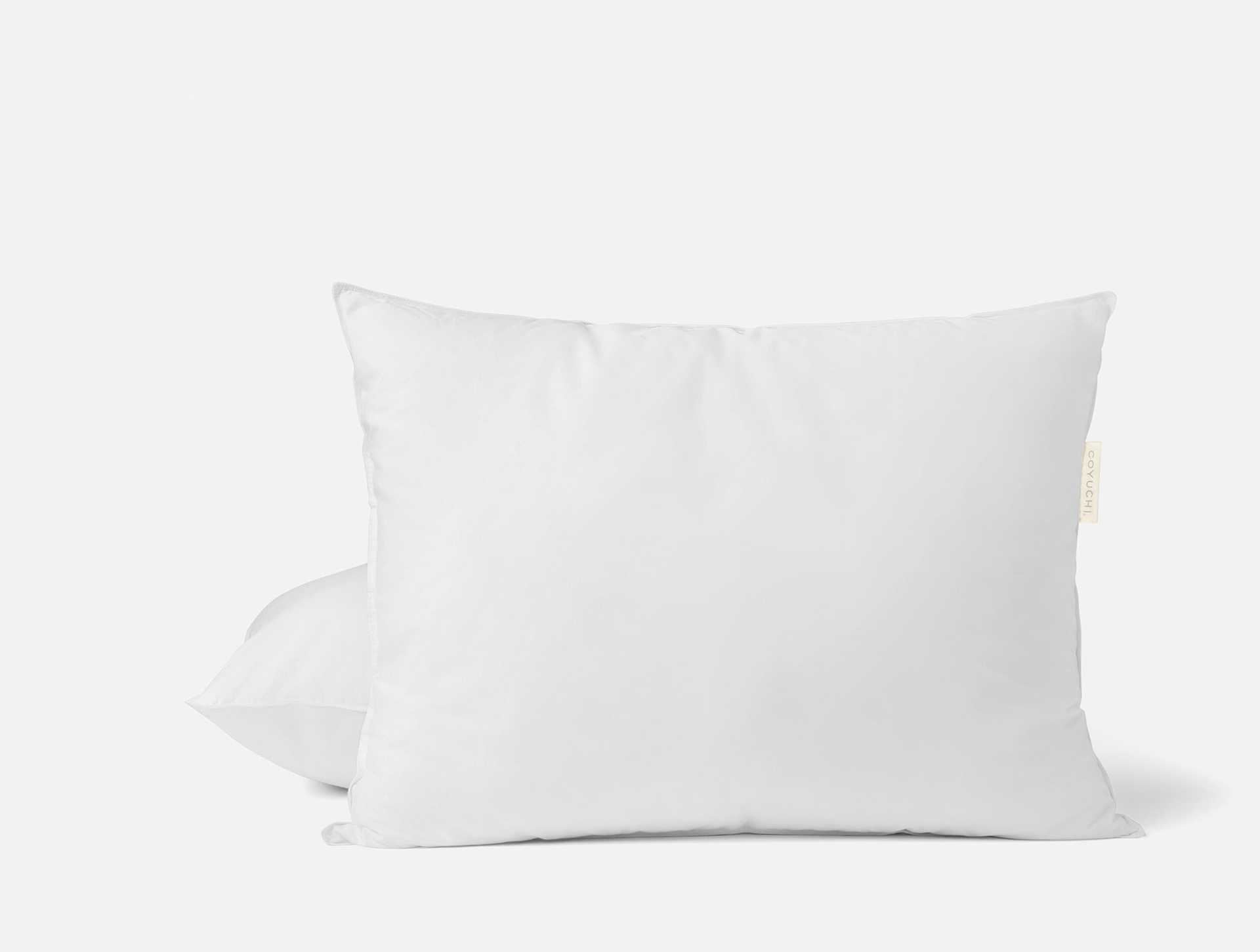
For example, the [Down Pillow](\/products\/down-pillow-5958) is described as containing responsibly sourced, double-washed down in a down-proof certified organic cotton shell. Its product description notes that it arrives lofty and thick, then compresses to its working thickness with use. That is a useful reminder that the first impression of loft is not the same as the lived-in profile. In assessing any pillow, the fill power—if specified—would still need to be considered alongside fill weight and construction.
When manufacturers do not publish every detail, it is reasonable to ask for clarification rather than infer a particular feel from one number. A product may be available in soft, medium, or firm versions, for instance, even when the listed fill power is identical. Those choices typically involve differences in fill quantity or design. The label’s firmness description may help, but it is still a broad guide, not a universal standard shared by every maker.
Matching loft to sleeping position
Sleeping position offers a practical starting point for thinking about pillow loft, although it cannot produce a perfect prescription. The goal is generally to keep the head and neck in a comfortable, relatively neutral position, rather than tilted sharply upward or allowed to drop toward the mattress. Body shape, mattress firmness, shoulder width, and personal preference all influence what that means in practice.
Side sleepers often need more height than people who sleep on their backs, because the shoulder creates space between the head and mattress. A pillow that is too low may allow the head to angle downward; one that is too high can push it upward. A firmer or more structured construction may help some side sleepers maintain a consistent height, though a high fill-power rating alone cannot tell you whether a pillow will do so.
Back sleepers may prefer a medium profile that cradles the head without pushing the chin toward the chest. The right amount of loft can vary with shoulder and neck shape, the mattress, and whether the sleeper prefers a more cradled or more level sensation. A pillow that compresses gently may work well for one person and feel insubstantial to another.
Stomach sleepers often find a lower, softer pillow more comfortable because a high profile can place the neck at an awkward angle. Some choose to sleep with no pillow beneath the head, or to use a low-profile option. Again, “soft” and “low” are not synonyms, and fill power does not establish either one on its own.
These are starting points, not rules. Many people change positions during the night, and a pillow may feel different when they are settled on their back than when they turn to one side. If possible, evaluate a pillow while lying down and allow a moment for the filling to compress. The question is less how dramatic the pillow looks in a product description than whether its working height feels comfortable for you.
Warmth, breathability, and the role of down
Because down traps air, it is associated with insulation. Fill power can help describe the down’s volume relative to its weight, and higher-fill-power down may provide a given degree of loft and insulation with less material. But a pillow is not a sleeping bag, and its warmth depends on more than the fill-power number. The quantity of down, the cover, the room temperature, pillowcase fabric, and the sleeper’s own temperature preferences all contribute.
Airiness is not the same thing as coolness. A lofty, breathable construction may allow air to circulate, but the pillow still contains insulating material. Some sleepers enjoy the light, compressible feel of down; others prefer a less insulating fill or a fabric that feels cooler against the skin. A cotton shell, for example, can have a different hand and airflow from a denser fabric, but the exact sensation depends on the weave and overall construction.
When warmth is a concern, look beyond fill power. Consider whether the pillow is described as lightweight or substantial, whether it contains a blend, and what the cover is made from. The bedding immediately around the pillow matters as well. A breathable pillowcase may change the surface sensation, while a protector can add another layer between the face and the shell.
Quality, sourcing, and what the number cannot certify
Fill power is a technical description, not a complete statement about how down was sourced, cleaned, handled, or incorporated into a finished pillow. A high rating does not by itself certify animal welfare, organic status, chemical safety, durability, or the accuracy of a brand’s other claims. Those issues require separate information and, where relevant, independent standards or documentation.
Buyers who care about sourcing can look for clear explanations of where the down comes from and what standards or certifications apply. They can also check whether the details refer to the down itself, the finished textile, or a particular stage of production. A certification name is most useful when the brand explains what it covers and the consumer can verify the standard through its issuing organization.
Likewise, “hypoallergenic” should be read with care. Processing and cleanliness may affect a person’s experience, but no general label can promise that a material will be suitable for everyone. People with a known allergy or sensitivity should consider their own history and consult an appropriate health professional when needed. A down pillow’s specifications are not a substitute for individual medical advice.
Care can preserve loft—or undermine it
Down clusters rely on their airy structure to expand. If they become damp, compressed, or coated with residue, the pillow may feel less buoyant. A pillow protector can reduce the amount of body oil, perspiration, and everyday soil that reaches the shell. Regular fluffing can redistribute the fill and help restore its shape between uses.
Washing directions vary by pillow, and the care label should take precedence over general advice. Some down pillows are suitable for careful machine washing; others may call for professional laundering. When washing is permitted, mild detergent, a suitable machine, thorough rinsing, and complete drying are important. A pillow that feels dry on the outside may still hold moisture in its center. Low, patient drying is often necessary, but always follow the manufacturer’s instructions.
Care is not a way to change fill power or permanently increase loft. It is a way to maintain the pillow’s intended condition. A pillow that has become persistently flat, lumpy, or difficult to refresh may have reached the end of its useful life, or may simply no longer suit the sleeper’s needs. Its original rating cannot tell you whether its present feel is right.
A more useful comparison method
Instead of asking which pillow has the highest fill power, begin with the sensation you want. Do you prefer a pillow that yields and can be folded into shape, or one that keeps a more stable profile? Do you want a low, soft surface, or greater height? Do you move between sleeping positions? These questions translate the abstract language of specifications into a practical shortlist.
- Choose a starting profile. Consider your usual sleep position and how much height feels comfortable against your mattress.
- Compare like-sized pillows. A standard pillow and a king pillow may contain different fill weights and behave differently.
- Read fill power with fill weight. Use both details to understand how loft may be achieved, rather than treating either as a complete verdict.
- Check construction and composition. Chambering, gussets, cores, and feather blends can alter the sensation as much as the down itself.
- Look at the shell and care requirements. The fabric touches your face, and maintenance affects how the pillow performs over time.
- Assess the pillow under real conditions. If a trial is possible, lie down in your usual position and consider the compressed, working loft.
If a product listing provides only a fill-power number, treat that as a starting point for questions, not the end of the investigation. Ask about the pillow’s fill weight by size, its firmness options, and its construction. If those details are not available, be cautious about claims that promise a specific level of support from fill power alone.
The number, in perspective
Fill power is useful precisely because it describes something specific. It offers a way to compare the volume occupied by a given weight of down and can help explain why some down is lighter and loftier than other down. It gives context to a pillow’s material—not a full account of the finished object.
To compare down pillows thoughtfully, place fill power beside fill weight, construction, dimensions, and the firmness you actually prefer. Consider how the pillow compresses under your head, whether its loft suits your sleeping position, and whether its care and sourcing details meet your expectations. A higher number may be a mark of greater loft potential, but potential is not the same as comfort.
The best pillow is not the one that wins a contest among labels. It is the one that feels right in the quiet, unremarkable hours when the room is dark and there is nothing left to compare. Fill power can help you understand what is inside it. Your own comfort completes the calculation.